Industrial PTFE Coating Service
AEGIS is an industrial PTFE coating manufacturer in Elkton, Maryland.
As a US based fluoropolymer coating manufacturer, AEGIS Advanced applies commercial grade PTFE, PFA, and FEP systems to industrial equipment from our climate controlled workshop. A Spectrum Advanced company. Our customers ship parts to Elkton from across North America because the controlled industrial oven cure delivers better service life than any field applied alternative.
Full service industrial PTFE coating applied to your assets, in your facility or in the field. Doctor blades, rolls, fixtures, heat seal bars, pump bodies, processing equipment exteriors. AEGIS specifies the right fluoropolymer system for the duty cycle, applies it under controlled conditions, and documents every step for regulated industries.
What is industrial PTFE coating?
AEGIS Advanced provides industrial PTFE coating services for manufacturers across the US. Whether you are searching for PTFE coating services near me or a partner who can apply non-stick fluoropolymer coatings in the field, our engineered PTFE coating process is built for demanding production equipment.
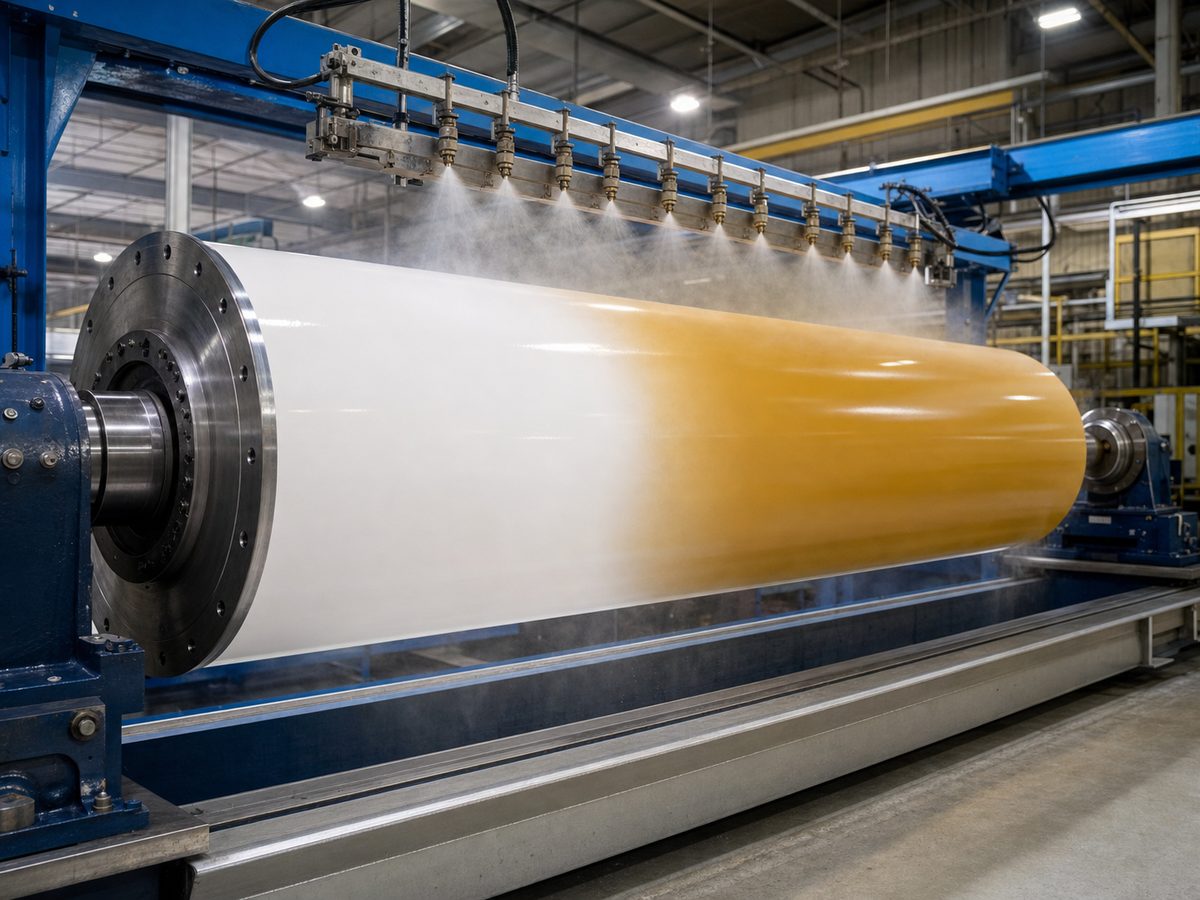
Industrial PTFE coating is a fluoropolymer surface treatment applied to metal substrates to deliver non stick release, low friction, chemical resistance, and corrosion protection in industrial duty cycles. Coatings are applied in layered systems tuned to the substrate, operating temperature, and exposure chemistry.
Types of industrial PTFE coating systems
- PTFE FP Series. General non stick and release applications across food, packaging, and converting equipment.
- PFA Series. Higher temperature service and aggressive chemical exposure.
- FEP Series. Transparent coatings and FDA contact applications in pharma and medical device packaging.
- Carbide reinforced fluoropolymer. Wear plus release in one system for doctor blades and abrasive contact surfaces.
Engineered, not sprayed and baked
Commodity PTFE applicators spray a standard formula onto whatever surface arrives at their facility. AEGIS works backward from your operating conditions. We start with the substrate, the duty cycle, the chemistry, and the failure mode. Then we select the fluoropolymer family, build the layer stack, set the cure profile, and validate the coating against your specification. The result is a coating sized to the asset, not a one size fits all film.
- PTFE FP Series. General low friction, non stick, and release applications across food, packaging, and converting equipment.
- PFA Series. Higher temperature service and aggressive chemical exposure where standard PTFE chemistry degrades.
- FEP Series. Transparent coatings and specific FDA contact applications in pharma and medical device packaging.
- Carbide reinforced fluoropolymer. Wear plus release in one coating system for doctor blades, slurry handling, and abrasive contact surfaces.
Field deployable application
For assets too large, too heavy, or too production critical to ship out for coating, AEGIS brings the line to you. Portable surface preparation, controlled application enclosures, and proprietary cure equipment travel to your plant. We coat the asset in place, document the work, and you bring the equipment back up the same shift in most cases.
This capability matters for paper machine rolls, calendering rolls, large structural members, installed bolt assemblies, and any asset where pulling for off site service is operationally impossible. For assets that cannot be shipped, learn about field deployable coatings and how our proprietary cure process replaces commodity oven cure.
Where this service belongs
Our PTFE coating services support plants nationwide, with field-deployable application that brings the service area to your facility instead of shipping heavy rolls and parts across the country.
AEGIS industrial PTFE coating is engineered for assets that operate in regulated, high duty cycle, or high consequence environments. Typical applications include heat seal bars on packaging lines, doctor blades on paper and tissue machines, rolls on converting and laminating lines, exterior surfaces in pharma and food processing including pump bodies and piping, and structural assets in marine and coastal service. The common thread across applications is a coating that has to perform, has to be documented, and has to come back to spec on a predictable recoat schedule.
For specific application detail see the heat seal bar coating, extreme wear coating, extreme release coating, and corrosion prevention coating pages.
PTFE vs ceramic and thermal spray coatings
Choosing between PTFE, ceramic, and HVOF thermal spray coatings comes down to the failure mode you are fighting. PTFE coating wins on non-stick release and chemical resistance at moderate temperatures; ceramic and HVOF thermal spray coatings win on hardness, wear, and high-temperature service. Because AEGIS applies both PTFE coating and HVOF thermal spray, we specify the system that matches your duty cycle instead of forcing one process.
Frequently asked
What makes AEGIS different from commodity PTFE applicators?
Commodity applicators run one or two PTFE products across every job. AEGIS selects the fluoropolymer family per application, builds a layered system tuned to the duty cycle, and applies proprietary cure rather than batch oven cure. The cost is somewhat higher per job, but recoat intervals stretch 2 to 4 times longer and the coating documentation supports regulated environments.
Do you coat OEM parts before they go into service?
No. AEGIS focuses on aftermarket recoat service for assets already in operation. We do not coat OEM parts off the assembly line. For new part coating, the OEM typically has an internal coating partner. For assets already in your plant that need a recoat, we are the right call.
What size assets can you coat in the field?
Field application capability covers rolls up to 60 inches in face length, structural members of any length, and installed bolt assemblies on wind turbines and bridge superstructures. For larger geometries we deploy multiple mobile units or stage the coating in sections. Send your asset spec and we will tell you exactly what is feasible.
Are AEGIS coatings FDA compliant?
Yes for the appropriate product family. PTFE FP Series and PFA Series formulations meet FDA 21 CFR 175.300 for indirect food contact. FEP Series formulations meet FDA pharmaceutical and medical device contact requirements. Compliance documentation is provided with every job.
What is the typical service life?
Service life depends on application. Heat seal bars in high duty cycle service: 4 to 7 months. Food processing rolls in moderate service: 9 to 12 months. Chemical processing equipment in continuous service: 3 to 5 years. AEGIS sizes the coating system to your specific cycle so recoats align with scheduled downtime.
How do I start?
Start with a coating review. Send us the asset, the operating conditions, and the current failure mode. We respond with a proposed coating system, a service life estimate, a per unit cost, and a mobilization schedule. No charge for the review.
AEGIS Advanced. A Spectrum Advanced company. Industrial coatings applied in your facility or in the field.