Bolt Corrosion Protection Coatings for Structural and Infrastructure Fasteners
AEGIS field deployable fluoropolymer corrosion barriers protect bolts and threaded fasteners on flanges, pressure vessels, and structural assemblies. Verified to 4,000 hours ASTM B117 salt spray, applied without removing the bolt from service.
Why bolt corrosion is hard to solve with conventional coatings
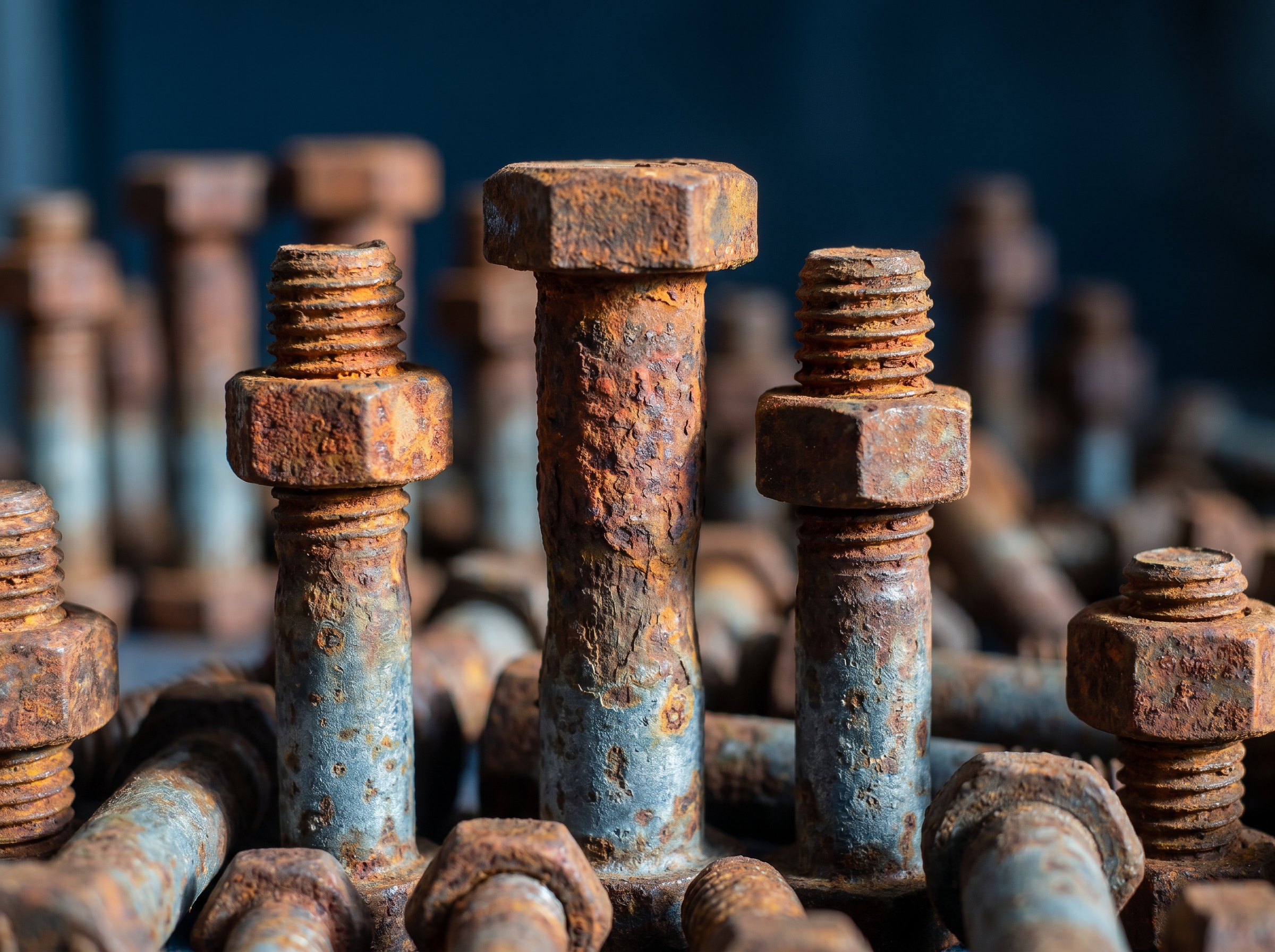
Bolts are one of the worst geometries for industrial coatings. Every thread, every flat, every radius needs to be uniformly coated, and the bond has to survive torque cycling, vibration, thermal cycling, and aggressive chemistry. Conventional grit blasting cannot reach into threads uniformly. Conventional shop cure requires removing every bolt, which is rarely practical on a live flange.
How AEGIS solves the bolt problem
- Proprietary surface preparation reaches every thread, every flat, every radius. No line of sight limitation.
- Chemical bond to the substrate survives torque cycling and thermal cycling without delamination at the bond line.
- Field deployable cure means we coat the bolt in place, on the flange, with no disassembly required for most service.
- Fluoropolymer corrosion barrier resists acids, caustics, chlorides, ammonia, and the marine chemistries that destroy zinc plated and galvanized bolts.
- Verified durability. 4,000 hours ASTM B117 salt spray with no undercut from a scribe.
Where AEGIS bolt protection matters most
- Flange bolting in chemical service: sulfuric, hydrochloric, caustic, chloride, and aggressive cleaning chemistries.
- Refinery and petrochemical flange bolts in H2S and sour service.
- Marine and offshore structural bolting in splash zone and salt air.
- Pulp and paper with chloride bleaching service.
- Power generation with steam, cooling water, and flue gas exposure.
- Wastewater and biosolids with H2S and chloride exposure.
Comparison with conventional bolt protection
| Capability | Zinc plated bolts | Galvanized bolts | Xylan or fluoropolymer dip coat | AEGIS field applied |
|---|---|---|---|---|
| Salt spray (ASTM B117) | ~100 hours | ~500 hours | ~1,000 to 2,000 hours | 4,000 hour verified |
| Chemical service range | Limited | Limited | Moderate | Excellent |
| Field deployable on installed bolts | No | No | No (must be coated then installed) | Yes |
| Thread coverage | Yes | Yes | Yes | Yes |
| Coating bond mechanism | Plating | Galvanic | Mechanical | Chemical |
| Recoat interval (typical chemical service) | 6 to 18 months | 1 to 3 years | 2 to 5 years | 10+ years documented |
How a bolt protection job runs
- Coating review. Send AEGIS the bolt size and grade, the flange and joint, the service chemistry, and the installation status. Engineering spec in one business day.
- Site survey if required. For large flange counts, AEGIS confirms access, permitting, and the work plan.
- Mobilization. Mobile prep and cure rigs arrive with documented procedures.
- Surface prep. Proprietary surface preparation on the installed bolts and exposed flange face, no grit, no waste.
- Coating application. Fluoropolymer corrosion barrier applied to spec.
- Cure. Proprietary cure process.
- Verification and handover. Coating thickness and cure documented per bolt or per joint as required.
Frequently asked
Do the bolts have to come off the flange?
Usually no. AEGIS field deployable surface prep and cure work on bolts already installed on the joint. Some service conditions or quality requirements may dictate removal, and we will tell you when.
What bolt sizes and grades can AEGIS coat?
Standard imperial and metric bolt sizes across carbon steel, alloy steel, and stainless. ASTM A193 B7, B8, B16, and similar grades. Special alloys on request.
Does the coating affect torque values?
Yes slightly. Coated bolts have a different K factor than bare or zinc plated. AEGIS supplies a torque adjustment factor with the coating spec so your torque procedure stays right.
Can AEGIS recoat bolts that already have a different coating?
Yes after stripping and verifying the substrate is sound. We assess and recommend strip and recoat or topcoat over existing depending on what we find.
How long does the coating last in service?
Documented field service life of 10 plus years in many chemical and marine applications. We quote expected service life with your spec based on the specific chemistry and cycling profile.
Spec bolt protection for your flange
Send AEGIS the bolt grade, the joint, the chemistry, and the installation status. One business day engineering response. Three day quote.