Corrosion Prevention Coatings
Chemical bond surface preparation and fluoropolymer corrosion barriers engineered for bolts, fasteners, pumps, structural steel, and process equipment. Fast facility turnaround for shippable parts. Field deployable cure for assets too large to ship like installed structural steel and anchor bolts in place. Verified to 4,000 hours ASTM B117 salt spray.
Why AEGIS corrosion prevention
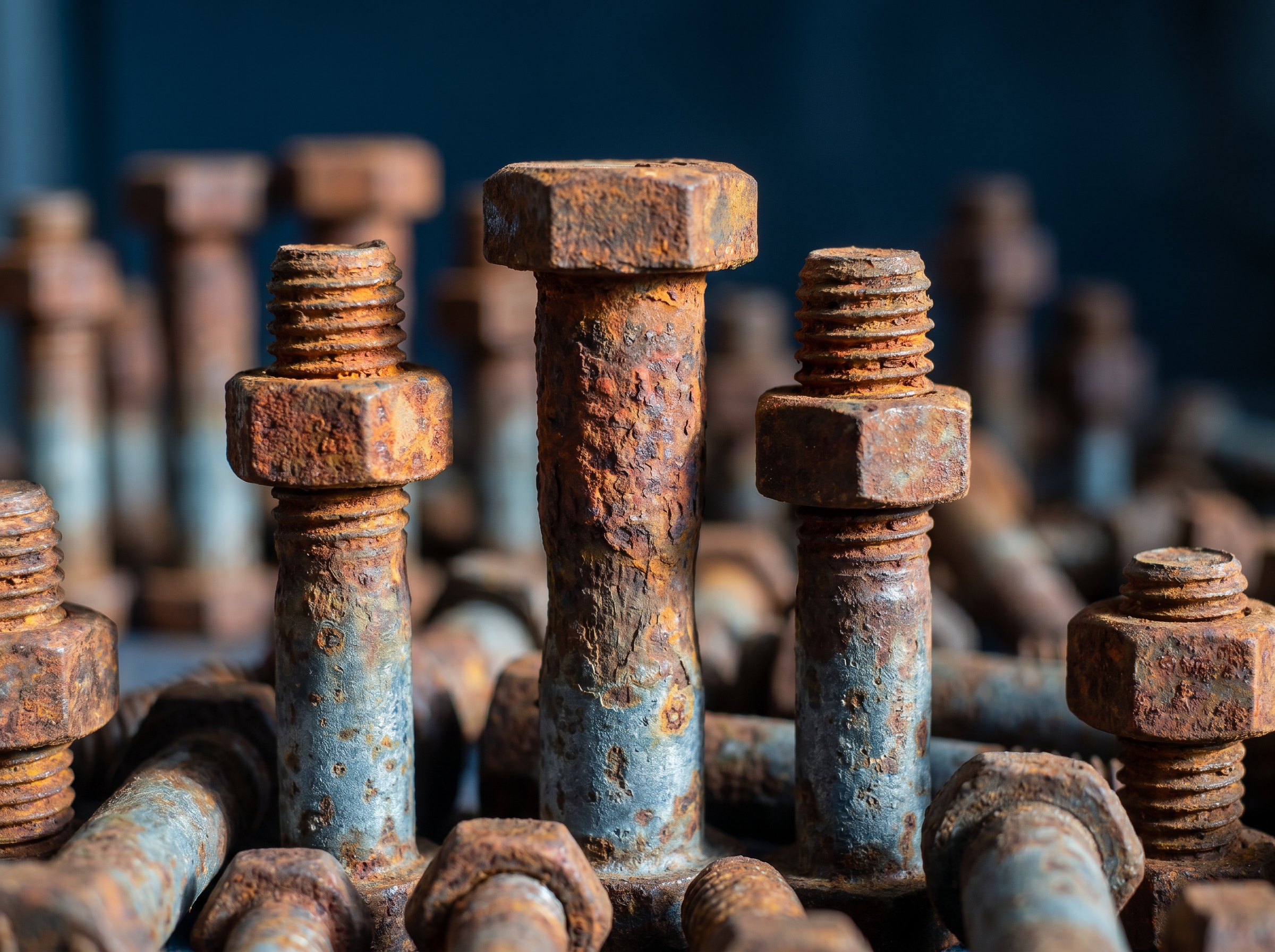
Most corrosion coatings fail at the bond line. Grit blasting embeds contamination, leaves a mechanical bond only, and misses pockets and threads. AEGIS solves the bond line at the root with proprietary surface preparation that creates a chemical bond, reaches every geometry, and generates no hazardous waste. Then we cure the coating with proprietary process heat activation, in our facility or on your equipment in place.
- CP400. Fluoropolymer corrosion barrier for chemical service, marine, and aggressive industrial atmospheres. 4,000 hour ASTM B117 verified.
- CP400F. Field deployable grade for bolts, fasteners, and structural steel that cannot come out of service.
How the coating works
Most coatings fail at the bond line, not the surface. AEGIS engineers that failure point out with a proprietary surface preparation and cure process that creates a chemical bond, reaches threads and pockets, and keeps the part dimensionally stable. In our shop or on your equipment in place.
Typical assets we coat
- Bolts and threaded fasteners on flange connections, pressure vessels, and structural assemblies in chemical service.
- Pumps and impellers handling acids, caustics, chlorides, and aggressive cleaning chemistries.
- Structural steel in marine, refinery, and chemical plant atmospheres.
- Marine hardware exposed to salt air, splash, and submerged service.
Industries served
- Oil and gas upstream, midstream, and downstream with H2S and sour service exposure.
- Chemical processing with acids, caustics, chlorides, and oxidizers.
- Marine and offshore handling salt spray, splash zone, and submerged service.
- Power generation with cooling water, flue gas, and steam side corrosion.
- Pulp and paper with chloride bleaching chemistries and aggressive cleaning.
What to send us
To spec the right corrosion system we need:
- Substrate material and existing coating, if any.
- Service chemistry: media, concentration, temperature, and pH.
- Geometry: bolt size and grade, pump model, part dimensions, or structural detail.
- Service environment: continuous immersion, splash, atmospheric, or thermal cycling.
- Whether the asset can be shipped to our facility or requires field deployable cure on site.
Buildup. Corrosion. Wear. We stop it.
One engineered platform against the three failure modes that take industrial equipment out of service, with the fastest turnaround in the field. A Spectrum Advanced company.
Buildup and sticking
Extreme release coatings shed adhesive, product, and fouling so rolls, seal bars, and process equipment stop dragging and stay in service.
See the coating →Corrosion
Corrosion prevention coatings protect assets in aggressive chemical and marine service, verified to 4,000-hour salt spray.
You are hereWear and abrasion
Extreme wear coatings, including HVOF tungsten carbide, extend the life of parts that erode, gall, or abrade in service.
See the coating →Frequently asked
How long does AEGIS corrosion prevention last?
Service life depends on the chemistry, temperature, and cycling profile. CP400 is verified to 4,000 hours ASTM B117 salt spray with no undercut from a scribe, and field service life of 10 plus years is achievable in many applications. We quote expected life with your spec.
Can AEGIS coat bolts already installed on a flange?
Yes. CP400F is engineered for field deployable application using AEGIS proprietary process heat activation. We bring the prep and the cure to the asset. No teardown required for most applications.
How does AEGIS compare to thermal spray for corrosion?
Thermal spray gives a sacrificial metallic barrier. AEGIS gives a fluoropolymer chemical barrier with a chemical bond to the substrate. We will tell you when thermal spray is the better economic answer for your service.
Is AEGIS corrosion prevention NACE or ISO certified?
AEGIS coatings have been tested to ASTM B117 (4,000 hour salt spray) and ASTM D870 (water immersion). Specific NACE and ISO conformity statements are available on request for your application.
What is the turnaround time on a corrosion job?
Engineering spec within one business day. Quote within three. Typical in shop turnaround is two to four weeks. Onsite work scheduled to your maintenance window.
Send us your corrosion problem
If corrosion is shortening service intervals or driving emergency replacements, AEGIS has the system for it. One business day engineering response. Three day quote.
What makes a coating corrosion resistant
A corrosion resistant coating works by interrupting the electrochemical reaction that drives metal loss. The coating either isolates the substrate from oxygen and electrolytes (barrier coatings), or sacrifices itself ahead of the substrate (zinc rich and galvanic coatings), or actively suppresses the corrosion reaction at the metal interface (inhibitor loaded coatings). AEGIS specializes in barrier and inhibitor systems built on fluoropolymer and ceramic chemistry. We do not run zinc rich coatings, which trade short term protection for messy maintenance.
How AEGIS corrosion resistant coatings perform
AEGIS systems are validated to ASTM B117 salt fog testing at 4000 hours, which is roughly 5 times the industry standard 800 hour pass. The coatings hold up to chemical exposure across pH 0 to pH 14, temperature cycling from minus 40 to 500 degrees Fahrenheit, and mechanical impact at standard plant duty cycles. For specifics on test methodology and certified results, see the resources library.
Choosing a corrosion resistant coating
What is the best corrosion resistant coating for steel?
For steel substrates in industrial service, multilayer fluoropolymer systems outperform single coat options. AEGIS layers an adhesion primer, a barrier midcoat, and a topcoat tuned to the operating environment. The combination beats single coat zinc rich, single coat epoxy, and electroless nickel in 4000 hour salt fog comparison. For chemical processing equipment exteriors, marine assets, and structural steel, fluoropolymer is the right answer.
How long does a corrosion resistant coating last?
Service life depends on operating environment. Atmospheric exposure: 7 to 12 years before recoat. Continuous chemical service: 3 to 5 years. Marine splash zone: 4 to 6 years. AEGIS sizes the coating layer stack to the specific environment, so service intervals match scheduled maintenance windows rather than fighting them.
What is the difference between corrosion resistant and corrosion proof?
Nothing is truly corrosion proof under industrial duty. Even precious metals corrode in the right chemistry. Corrosion resistant coatings extend service life by orders of magnitude over uncoated metal, but every coating system has a service envelope. AEGIS specifies the envelope up front so you know exactly when to schedule the next recoat.
Can corrosion resistant coatings be applied in the field?
Yes. AEGIS specializes in field deployable application. We bring portable surface preparation, controlled application enclosures, and proprietary cure equipment to your facility. Most assets stay in place during coating, which means no shipping, no spare rotation, no extended downtime. See field deployable coatings for full capability.
Is the coating FDA compliant for food contact?
Yes for the appropriate product family. AEGIS FP Series and PFA Series formulations meet FDA 21 CFR 175.300 for indirect food contact. For pharmaceutical and medical device applications, FEP Series formulations meet the stricter contact requirements. Compliance documentation is provided with every job.