
FDA Grade PTFE Coating for Pharmaceutical Manufacturing
Pharma manufacturing demands more from PTFE coatings than any other industry. The coating has to be FDA listed for repeated contact, it has to survive caustic and acid clean in place chemistry, and the documentation has to drop straight into your validation file. AEGIS Advanced coats pharma reactor mixers, blade tips, transfer rolls, and discharge chutes with FDA 21 CFR 175.300 compliant fluoropolymer systems engineered for the validation environment.
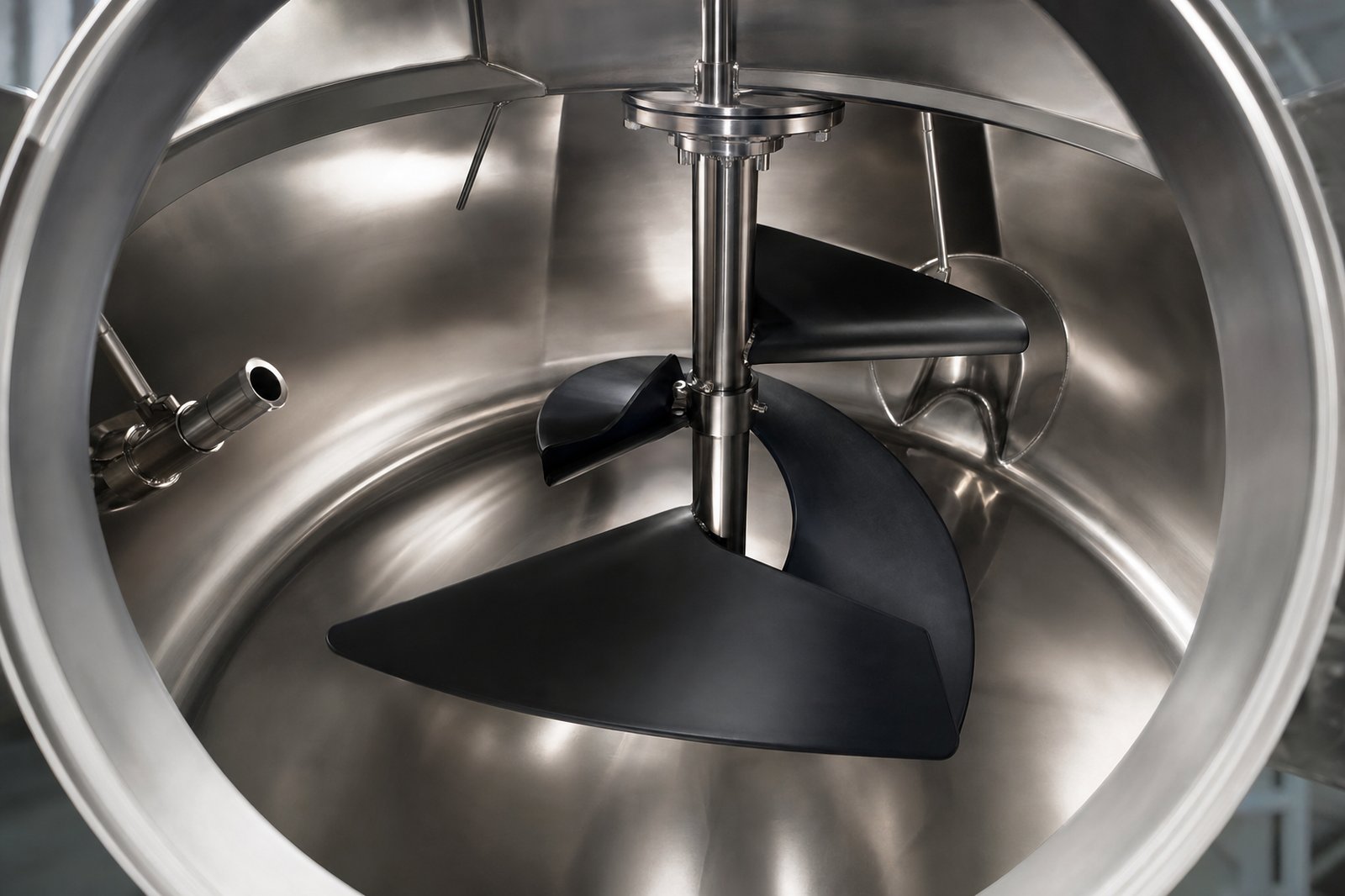
What makes a PTFE coating FDA grade
An FDA grade PTFE coating system has to satisfy three separate requirements that commodity PTFE rarely meets:
- FDA 21 CFR 175.300 listed resins. The fluoropolymer base resin must appear in the FDA indirect food additive list at the formulation and cure conditions used.
- Documented application chain. Surface prep abrasives, primer chemistry, top coat batch records, cure profile, and final dimensional inspection all have to be traceable per part.
- Validation ready paperwork. Material certs, FDA listing letter, surface profile report, and AEGIS in process inspection records package with each job.
Pharma applications AEGIS coats most often
- Reactor mixer blades and impellers: low friction PTFE prevents API agglomeration on blade surfaces and reduces clean in place cycle time.
- Reactor walls and discharge chutes: API release coating that survives the SOG and SIP cycles between batches.
- Transfer roll surfaces: granulation transfer, lamination transfer, and coating pan transfer rolls all need PTFE that releases product without trapping residue.
- Filter press plates and frames: PTFE on filter plate surfaces extends plate life through the harsh acid wash cycles.
- Granulator and mill internals: tight tolerance PTFE coatings on Comil and high shear granulator internals reduce changeover time.
Validation file content AEGIS provides

Every pharma job ships with:
- FDA 21 CFR 175.300 compliance letter for the specific fluoropolymer resin used
- Substrate certification (typically 316L or Hastelloy)
- Surface preparation method documentation (grit type, grit size, profile target)
- Coating batch records with primer and top coat batch numbers
- Cure profile chart with time and temperature trace
- Dimensional inspection report (pre and post coating, with delta)
- Surface profile inspection (Ra and Rz measurements)
Your validation team gets a package they can drop into the equipment qualification file without follow up questions.
The cleaning chemistry problem
Pharma cleaning chemistry kills commodity PTFE coatings. Sodium hydroxide at 80 C, peracetic acid, and high pressure water all attack the coating before they attack the resin from the previous batch. AEGIS specifies a multilayer fluoropolymer system with chemical resistant primer chemistry that survives the cleaning cycle without surface erosion. We test every batch sample on coupon panels exposed to your specific cleaning chemistry before we coat the production part.
Recoat cadence for pharma equipment
Pharma recoat cadence depends on duty cycle, cleaning regime, and product chemistry. Typical AEGIS pharma recoat intervals run 18 to 30 months. Reactor mixer blades on heavy duty API production hit the lower end. Granulator internals and transfer rolls in pellet and tablet production hit the upper end. We document the inspection at recoat so you can trend equipment performance and plan future shutdowns.
Request a pharma PTFE coating evaluation
Send the part identification, substrate material, cleaning chemistry exposure, contact product, and current coating spec if any. AEGIS engineering responds with a validation file package preview and quote within 48 hours.