PTFE Coating Service: AEGIS Engineering Versus Commodity Applicators
Most PTFE coating shops sell on price for small parts. AEGIS Advanced sells engineering for parts that fail in service. Both business models are legitimate. Picking the wrong one for your application is expensive. This page walks through the actual differences so you can decide which fits your job.
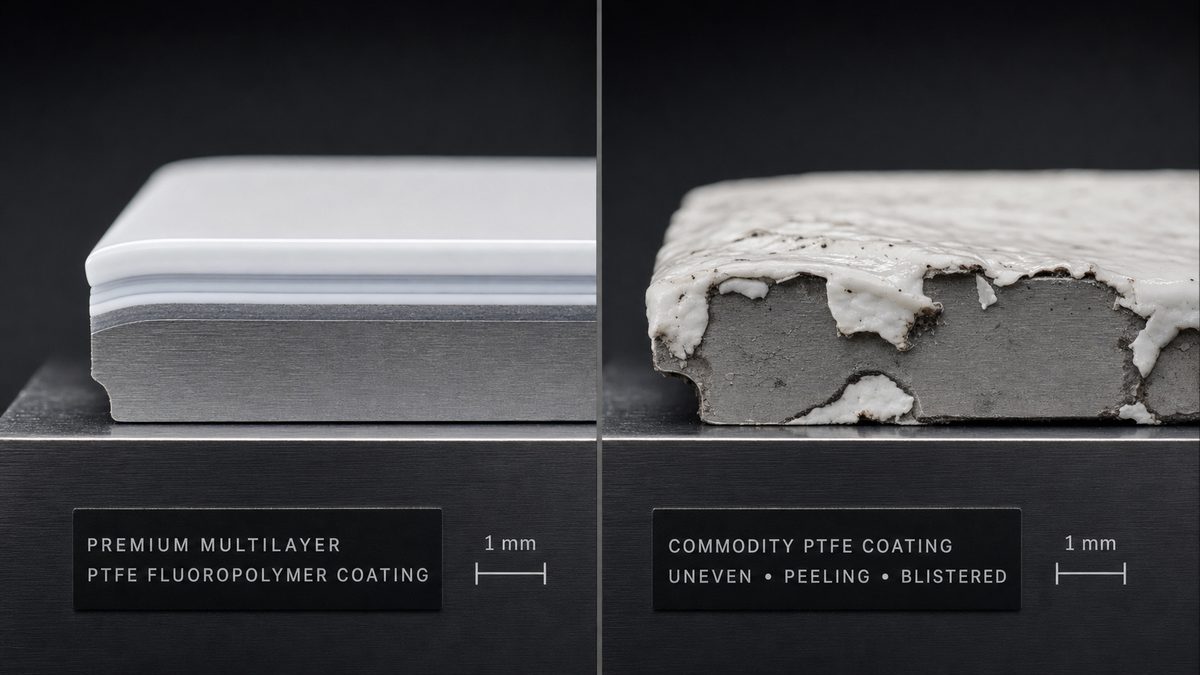
When commodity PTFE coating is the right call
A commodity applicator is the right choice when:
- The part is small (fits in a shoebox)
- The part is not FDA regulated
- The service environment is mild (room temperature, no chemistry, low duty cycle)
- The recoat cadence does not matter
- The lowest possible unit price wins the work
Most PTFE coating shops are excellent at this. They run high volume, they keep overhead low, and they ship reliably. If your part fits the description, AEGIS will refer you to one of them.
When AEGIS engineering is the right call
AEGIS is the right choice when:
- The part is FDA regulated and the documentation matters
- The part is too big or too heavy to ship economically
- The duty cycle is severe (continuous high temperature, abrasive, chemical attack)
- Down time costs more than coating
- You need recoat scheduling, dimensional inspection, and predictable budget over multiple years
- The part has to be coated in place because it is embedded in operating equipment
Side by side comparison
| Capability | Commodity applicator | AEGIS Advanced |
|---|---|---|
| FDA compliance letter on every job | Sometimes | Always |
| Validation file documentation package | Generic spec sheet | Per job records: batch numbers, cure profile trace, dimensional inspection |
| Field deployable service | No | Yes, North America wide |
| On-site cure cure | No | Yes, patent pending equipment |
| Maximum roll face length | Typically 12 feet (oven limit) | 60 feet with in situ cure |
| Multilayer fluoropolymer systems | Single layer typical | Multilayer primer plus top coat tuned per application |
| Cleaning chemistry resistance testing | Generic | Coupon tested against your specific cleaning chemistry |
| Approved vendor list onboarding | Limited | ISO 9001, insurance, OSHA records, past performance references |
| Recoat scheduling and inspection | Per call | Standing schedule with dimensional inspection at every cycle |
| Per part minimum | Low (typically under 500 dollars) | 2,000 dollar floor, 10,000 dollar typical, 100,000 dollar hero projects |
| Patent backed technology | No | Patent pending cure method |
The total cost question
Unit price is the wrong metric for industrial PTFE coating. Total cost of service is the right metric. Three line items drive total cost:
- Coating unit price: AEGIS is higher than commodity applicators on small parts. We do not chase that work.
- Down time during recoat: AEGIS coatings last 2 to 3 times longer than commodity PTFE in severe service. Fewer recoat events means fewer line stops.
- Freight and handling: shipping a 40 foot roll for shop coating versus AEGIS field service on site changes the freight line item by an order of magnitude.
For severe service applications, AEGIS total cost runs lower than commodity over a 36 month operating window even though our unit price is higher. We will show you the math on your specific application if you ask.
How AEGIS quotes versus how commodity shops quote
A commodity shop quotes from a part description in a few hours. AEGIS engineering reviews the part substrate, service environment, cleaning chemistry, contact medium, current coating performance, and recoat history before quoting. The quote includes the coating system specification, the cure approach, the documentation package, and the inspection regime. Quote turnaround is typically 24 hours for shop work and 48 hours for field service.
Compare AEGIS to your current applicator
If you have a current PTFE coating supplier and want a side by side evaluation on a specific part, send the part identification, current coating spec, current recoat interval, and the failure mode you are seeing. AEGIS engineering will return a written comparison showing where our system differs and what the projected service life would be on your application.